

Solar projects & energy Storage
Tower Road Solar
Status:
Designing clean energy with the community
The proposed Tower Road solar project in Pelham, Massachusetts is designed to generate clean, locally produced energy. Even at this stage of the development, the project’s design has been refined in response to community feedback.
Status (2026)
In Development
Tower Road Solar is in the early stages of development and is expected to become operational in 2028 or 2029.
Proposed Capacity (AC/DC)
4 MWAC / 4.4 MWDC
Rated output of 4 MWAC (grid export) and 4.4 MWDC peak solar capacity.
Project Footprint
~36 acres
Area occupied by solar arrays.
Tower Road Solar Overview
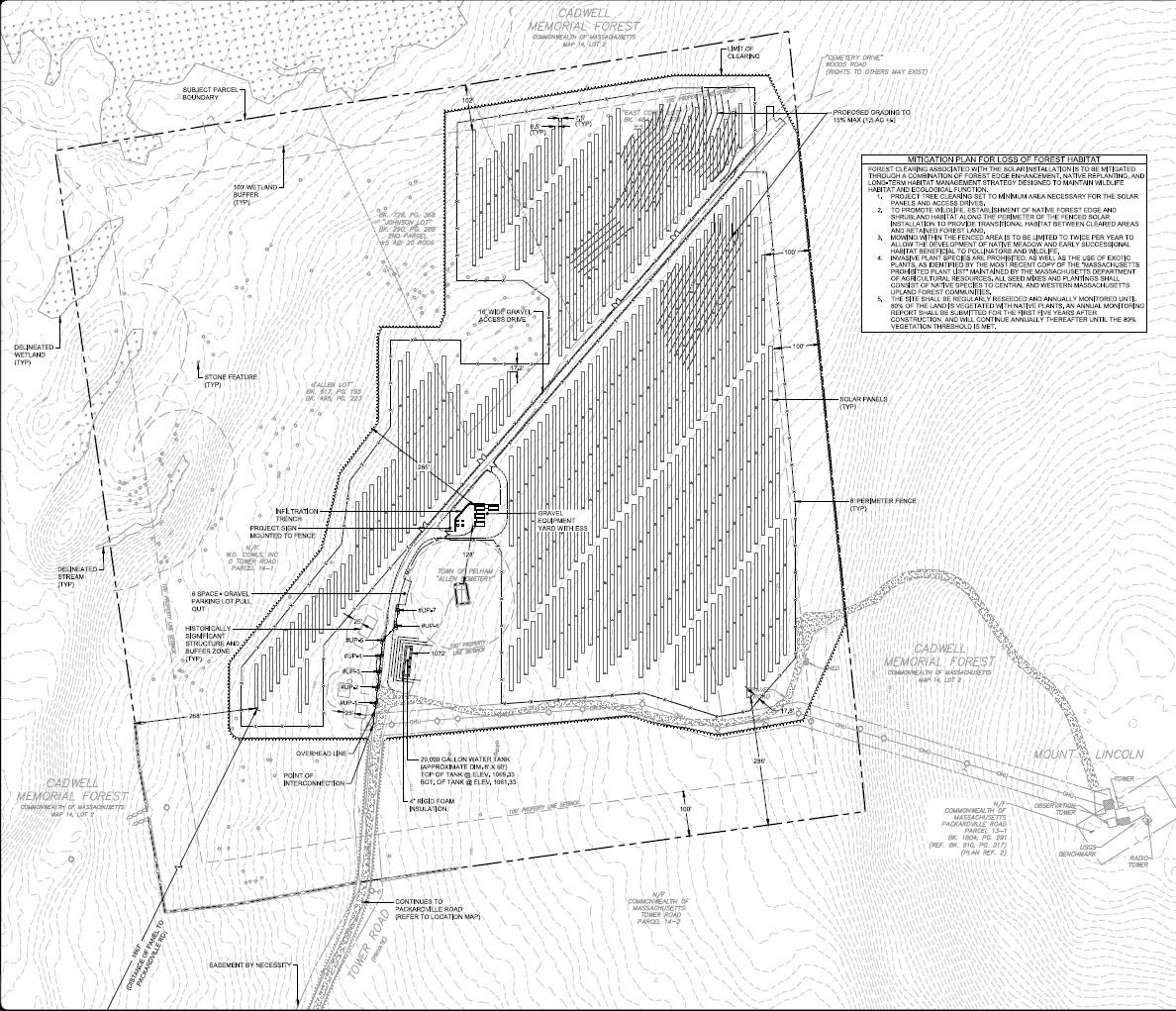
The Tower Road Solar Project is a proposed 4.4 MWDC community solar and battery storage facility located on a privately owned parcel off Tower Road in Pelham, Massachusetts. Designed to generate clean, locally produced energy, the project has been carefully refined to reduce environmental impacts, avoid wetland buffer areas, and preserve important cultural and natural features on the site, including nearby historic resources and existing trail access.
SOLAR SITE HIGHLIGHTS
- Location: Pelham, MA
- Solar Panels: 11,674 bifacial units
- Estimated Annual Energy Generation: ~8,400,000 kWh
- Proposed System Capacity: 4,400 kW DC

Documents
Solar brings measurable change
Environmental and Community Impacts
The proposed Tower Road Solar Project in Pelham will generate local, affordable clean energy while thoughtfully balancing environmental stewardship and community priorities. By expanding access to renewable energy, supporting local economic activity, and helping strengthen grid reliability, Tower Road Solar will deliver long-term benefits to residents, businesses, and the broader community.
642
Equivalent of Homes Powered for One Year
8,174,776 lbs
Annual CO2 Reduction Equivalent

865
Equivalent of Gas-powered Cars Driven for One Year
* The above numbers were calculated using the EPA’s Greenhouse Gas Equivalencies Calculator, accessed at https://www.epa.gov/energy/greenhouse-gas-equivalencies-calculator
Project Development Timeline
Early Environmental Studies
2020
Initial environmental fieldwork, including wetland assessments, helped identify site conditions and guide responsible project planning. These studies established an important baseline for future permitting and design work.
Cultural Resource Research
2021
Specialists completed cultural and archaeological fieldwork in consultation with Tribal representatives to better understand the site’s history and identify any culturally significant features that should be considered during project development.
Land Agreement
2022
PureSky entered into a lease option agreement with the property owner.
Grid Interconnection Studies
2022-2023
Engineering studies were conducted to evaluate how the project could safely connect to the electric grid and identify any required system upgrades.
Project Design Refined
Spring 2025
The project team updated the site layout and incorporated battery energy storage into the design. These refinements focused on improving project performance while addressing community and site-specific considerations.
Community and Safety Discussions
Spring 2026
PureSky, Town representatives, and technical experts worked together to review questions related to the battery energy storage system, emergency response planning, and project design options.
Community Outreach and Pre-Permitting Engagement
Summer 2026
First pre-permitting public meeting held to gather feedback, answer questions, and share project information with residents and local stakeholders. There will be more opportunities for public feedback in the future.
Questions or Feedback?
Fill out the form at the bottom of this page and we’ll get back to you.
Next Steps
Over the coming years, the project will continue through permitting, final engineering, and procurement activities before construction can begin. The current development schedule targets commercial operation in late 2028, subject to permitting, interconnection, equipment availability, and construction timelines.

PureSky Massachusetts
Where PureSky Builds Solar and Energy Storage
PureSky Energy is proud to be part of Massachusetts’ clean energy leadership. With 26 MW of solar generation and 31 MWh of battery energy storage and in operation, our projects help the Commonwealth meet ambitious climate goals while strengthening local communities. Each project is designed with careful attention to environmental stewardship and long-term community benefits.
Explore our community solar farms below.
Frequently Asked Questions
What is community solar?
Community solar allows residents, businesses, nonprofits, and municipalities to benefit from solar energy without installing solar panels on their own property. Instead, participants subscribe to a portion of the electricity generated by a local solar project and receive credits on their electric bills.
Community solar makes clean energy more accessible for people who rent, have shaded roofs, or aren’t able to install rooftop solar. Subscribers receive guaranteed savings on the electricity supplied through the program, and qualifying low-income households may be eligible for additional savings.
Once the Tower Road Solar Project is operational, residents and businesses in Pelham and the surrounding area will have the opportunity to subscribe and receive savings on their electricity bills.
Why was this site selected?
PureSky evaluated multiple locations in the area before selecting this one. This site stood out because it already has infrastructure that can support a solar project, including nearby electrical interconnection capacity. That allows renewable energy to be generated while reducing the need for additional disturbance elsewhere.
Throughout the design process, we’ve worked to minimize impacts by reducing the project’s footprint, preserving the existing trail that runs through the site, avoiding an historic cemetery and ceremonial stones, and limiting disturbance to surrounding forest wherever possible.
Our goal has been to balance renewable energy generation with protecting the site’s environmental, historic, and recreational resources. We’ll continue working with the Town, local organizations, and community members to refine the project as it moves through the permitting process.
How will the project protect trails, the cemetery, and historic and cultural resources?
Protecting the site’s historic, cultural, and recreational resources has been a key consideration throughout the design process.
The existing trail that residents use for hiking, cross-country skiing, and mountain biking will remain in place. We redesigned the project earlier this year specifically to preserve that trail.
PureSky has also worked with archaeological consultants, the Massachusetts Historical Commission, and representatives from Tribal communities to identify and avoid ceremonial stone features and other historic resources. The project has also been designed to maintain a setback from an historic cemetery located on the site, and we’ll continue working with Tribal leaders, the Cemetery Commission, Historical Commission, and other local stakeholders throughout the permitting process to help protect these important resources while maintaining continued access to the cemetery.
How will the project protect the surrounding environment?
PureSky has designed the project to minimize environmental impacts while creating opportunities to improve habitat over the long term.
Only a portion of the site will be developed, with much of the surrounding forest remaining undisturbed. Areas beneath and around the solar panels will be planted with native, pollinator-friendly vegetation to create a managed meadow habitat – an increasingly uncommon landscape – that supports birds, butterflies, bees, and other wildlife.
We will not use herbicides for routine vegetation management. Instead, the site will be maintained primarily through periodic mowing and the establishment of native vegetation.
The project will also include a comprehensive stormwater management plan designed to protect nearby wetlands and groundwater. Additional environmental studies and permitting reviews will continue as part of the Planning Board review process.
Why does the project include battery energy storage?
The battery energy storage system stores clean energy generated by the solar farm when production is high and delivers it to the grid when demand is high, or sunlight is limited. This helps improve grid reliability by making clean energy available when it’s needed most.
How will the battery energy storage system be operated safely?
PureSky’s battery energy storage system is designed with multiple layers of safety protections and must comply with national fire and electrical safety standards, Massachusetts regulations, and local requirements. The system will include continuous monitoring, automatic safety controls, fire-rated enclosures, and containment measures designed to quickly detect and respond to potential issues.
Battery fires are uncommon, but safety is built into every stage of the project. PureSky will continue working closely with the Pelham Fire Department on emergency planning and response procedures. If any additional training or equipment is needed before the system begins operating, PureSky will provide it at no cost to the Town. The project also includes a proposed 20,000-gallon underground water tank that would be available to support emergency response if ever needed.
How will the project benefit the Town of Pelham and its residents?
The project is expected to provide several long-term benefits for Pelham.
It’s expected to generate new local tax revenue through property taxes or a Payment in Lieu of Taxes (PILOT) agreement over the life of the project. Because the project is privately funded, there are no public construction costs, and we’ll be responsible for maintaining the facility and funding its eventual decommissioning.
Residents and businesses will have the opportunity to subscribe to community solar and receive guaranteed savings on their electricity bills, with additional savings available for qualifying low-income households.
The project would also provide a new resource for local firefighters. In addition to supporting project operations and maintenance, the proposed 20,000-gallon underground water tank would be available to the Pelham Fire Department and other emergency responders in an area without a nearby water source.
What should residents expect during construction?
Construction is expected to last approximately six to nine months, with most heavy activity occurring during the first few months of the project.
Residents can expect construction equipment, delivery trucks, and workers on site during this period. We’ll work to minimize disruptions while maintaining safe access to the site and coordinating with the Town throughout construction.
Once construction is complete, routine activity is minimal and generally consists of periodic inspections, vegetation management, and equipment maintenance. Solar projects do not generate regular traffic, and ongoing operations require only occasional site visits.
How long will the project last, and what happens when it reaches the end of its life?
Community solar projects are designed to operate for approximately 25 to 35 years.
When the project reaches the end of its life, PureSky will remove the equipment and restore the site. As part of the permitting process, we’ll also set aside funding to ensure the project can be properly decommissioned without cost to the Town or taxpayers.
How can residents stay informed and provide input as the project moves forward?
The Pelham project is still in the early stages of the permitting process, and there will be several opportunities for residents to learn more, ask questions, and share feedback.
PureSky will continue working with the Planning Board, Town officials, local organizations, and community members as the project is reviewed. Additional public meetings and hearings will be held as part of the permitting process, and we also plan to host community information sessions where residents can learn more about the project, ask questions, and share feedback.
We’re committed to continuing these conversations and refining the project wherever possible as the review process moves forward.
Questions or Feedback?
Fill out your question or feedback in the comments section below and a member of our team will get back to you.