

Some pumpkins are too small. Some grew too late. Some got too much water. And in parts of Texas, there simply aren’t enough of them. Welcome to Halloween 2026.
Finding the perfect pumpkin is usually one of autumn’s easier traditions. You head to a farm stand or pumpkin patch, inspect an unreasonable number of nearly identical orange gourds and finally find the one.
This year, depending on where you live, the hunt may be a little trickier.
Across parts of the United States, Canada, and the United Kingdom, pumpkin growers have faced remarkably different challenges. Texas and England have battled extreme drought. Ontario farms have dealt with waterlogged fields. Cold, wet conditions slowed pumpkins in Newfoundland and Labrador.
It’s enough to make you wonder whether the scariest thing in the pumpkin patch this Halloween isn’t the jack-o’-lantern.
Taken together, these harvests offer a surprisingly relatable window into a much bigger issue: how farmers adapt when familiar growing seasons become less predictable.

A Pumpkin’s Biggest Ingredient? Water.
Pumpkins may look sturdy, but growing them takes the right combination of moisture, warmth and time.
And 2026 has provided some dramatic examples of what happens when that balance gets thrown off.
In England, drought and an extraordinarily hot, dry summer left many Halloween pumpkins smaller than usual. According to reporting from The Guardian, pumpkins are about 90% water, making adequate moisture particularly important as the fruit develops.
Some growers even suggested reconsidering the annual quest for an enormous carving pumpkin. Smaller squash can be decorated for Halloween and, unlike a jack-o’-lantern destined for the compost pile, eaten afterward.
There’s even a historical precedent. Long before pumpkins became synonymous with Halloween, people in Britain carved root vegetables such as turnips as part of traditions associated with Samhain.
So if your 2026 pumpkin looks a little underwhelming, you could always call it historically accurate.

In Texas, Drought Took a Big Bite out of the Harvest
The hot, dry conditions weren’t confined to Europe.
In Floyd County, known as the “Pumpkin Capital of Texas,” extreme drought and relentless summer heat took a significant toll on the 2026 crop.
According to Texas A&M AgriLife Extension reporting provided for this article, pumpkin yields in Texas’ primary production area were down an estimated 30% to 40%. Mark Carroll, an AgriLife Extension agriculture and natural resources agent for Floyd County, called 2026 the driest year he had seen in the county during his 20 years as an extension agent.
Texas growers planted about 1,200 acres of pumpkins this year. Those acres are irrigated, primarily with drip systems, but even irrigation could not fully compensate for the conditions.
The problem started below the surface.
Growers entered the season with little to no subsoil moisture. Normally, Carroll explained, farmers begin the growing season with some moisture already stored in the soil and use irrigation to supplement it. This year, that reserve wasn’t there.
The difficult season also ended earlier. Harvest, which typically begins around September 1, was expected to finish one to two weeks earlier than normal, in part because there were fewer pumpkins to pick.
There was one strange silver lining. Pumpkins are highly susceptible to fungal diseases, and the unusually dry conditions meant farmers needed fewer applications to control them.
Even in a difficult growing year, agriculture rarely gives us an entirely simple story.
Meanwhile, Ontario Had Almost the Opposite Problem
Travel north to Ottawa, and the pumpkin plot thickens.
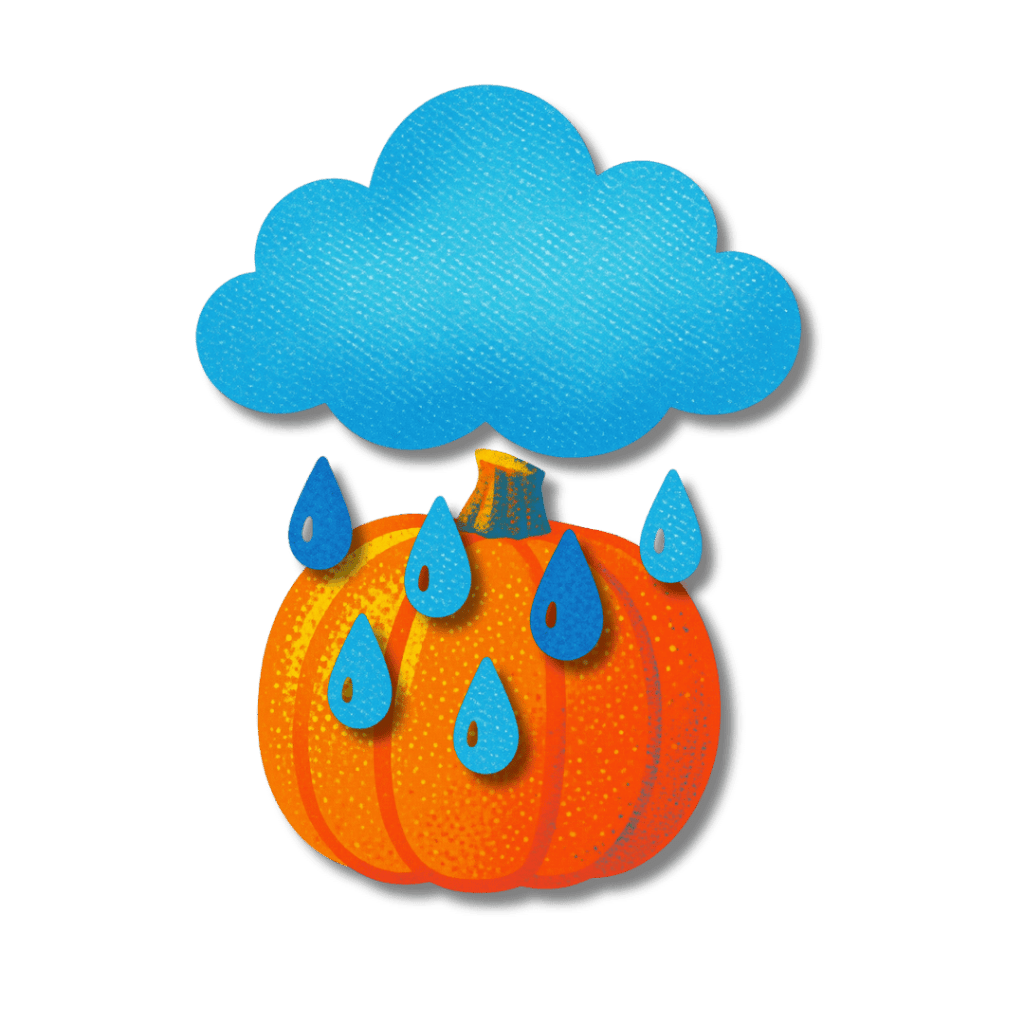
Instead of too little water, some farmers faced far too much of it.
According to Capital Current, Ottawa received more than 280 millimetres of rain in July alone, more than four times the historical average cited by the publication. June and August also saw more than double their average rainfall.
In some low-lying fields, the results were decidedly un-festive: waterlogged ground, softer pumpkin skins and premature rot.
Drainage suddenly became a major advantage.
One Ottawa-area farm told Capital Current that its well-drained land helped protect its harvest while other growers struggled. Some neighboring farms ultimately purchased pumpkins in bulk from operations that had fared better.
Other farms weren’t so fortunate. CBC reported that Saunders Farm in rural Ottawa estimated its 2026 pumpkin crop was down by at least 40%.
Too little water hurts pumpkins.
So, apparently, does too much.

In Newfoundland and Labrador, Pumpkins Hit the Snooze Button
Farther east, growers encountered yet another variation of the Great Pumpkin Problem.
Cold, wet summer conditions slowed pumpkin growth in Newfoundland and Labrador.
At Lester’s Farm in St. John’s, the harvest was reportedly about two weeks behind. At another farm, roughly 3,000 pumpkin seeds were planted, but only a couple hundred produced pumpkins after cold conditions early in the growing season affected the crop.
There was, however, another pumpkin paradox.
The fruit that did grow benefited from abundant moisture. Farmers reported good size and quality.
One grower summed up the contrast particularly well: the previous year brought more pumpkins but lower quality, while 2026 delivered better-quality pumpkins but fewer of them.
That’s farming.
And increasingly, it’s farming under changing conditions.

The Great Pumpkin Weather Map of 2026
Put these regional stories side by side and Halloween starts looking like a miniature lesson in climate variability.
Texas: Extreme drought and heat contributed to pumpkin yields falling an estimated 30% to 40% in the state’s primary production region.
England: A hot, dry summer and drought left many Halloween pumpkins smaller than usual.
Ottawa, Ontario: Heavy summer rainfall waterlogged some fields, contributing to softer pumpkins, rot and crop losses. Saunders Farm estimated its crop was down at least 40%.
Newfoundland and Labrador: Cold and wet conditions slowed pumpkin development, pushing one farm’s harvest roughly two weeks later than usual.
Elsewhere in the United States: Growers have also reported a difficult season, with CityNews highlighting warnings that the 2026 pumpkin harvest could be among the worst in years.
That’s an extraordinary range of problems for one relatively simple crop.
But there’s an important distinction to make.
A bad pumpkin harvest, or even several bad harvests, doesn’t by itself prove climate change.
Weather has always varied from place to place and year to year. Climate change describes longer-term changes in the climate system and the conditions surrounding individual seasons and weather events.
What farmers increasingly have to manage is uncertainty.
Too little water can stunt a pumpkin. Too much can waterlog soils and contribute to rot and disease. Cold conditions can delay growth. Extreme heat and drought can stress crops and reduce yields.
And farmers have to make decisions about seeds, irrigation, drainage, labor and equipment long before they know exactly which version of summer they’re going to get.
You can’t wait until Halloween to discover what kind of growing season you’re going to have.
Share Community Solar this Halloween

Farming Has Always Meant Adapting. Climate Change Raises the Stakes.
The differences between these 2026 harvests also reveal something encouraging: adaptation matters.
In Texas, even extensive irrigation couldn’t fully overcome the combination of drought and depleted subsoil moisture.
In Ontario, farms with better-drained fields were better positioned to cope with excessive rainfall.
In England, growers experimented with ways of retaining moisture around pumpkin plants during drought.
And in Newfoundland and Labrador, farmers are reconsidering how they grow crops amid increasingly variable conditions.
There isn’t one climate adaptation that works everywhere because there isn’t one climate challenge everywhere.
For a pumpkin farmer in Texas, keeping enough water available may be the challenge.
For a pumpkin farmer near Ottawa, getting excess water off the field may be just as important.
That captures one of the trickiest realities of adapting agriculture to a changing climate: resilience means preparing for a wider range of conditions, not simply preparing for hotter weather.
Don’t Waste a Perfectly Good Pumpkin
There’s another climate connection hiding inside our jack-o’-lanterns: what happens after Halloween.
The familiar giant carving pumpkin has essentially become part decoration, part seasonal ritual. But pumpkins and winter squash are also food.
One of the growers interviewed by The Guardian questioned the logic of using land, water and other resources to grow a crop that may simply be discarded after Halloween. His suggested alternative was delightfully straightforward: decorate smaller edible squash and then eat them.
It might be an idea worth adding to our Halloween traditions.
If your uncarved pumpkin remains in good condition after October 31, consider cooking with it where appropriate or composting it rather than sending it to the trash. Decorative edible squash can provide both the autumn centerpiece and dinner.

Maybe the Perfect Pumpkin Doesn’t Have to Be Perfect
There is something charmingly appropriate about a slightly crooked, undersized or oddly shaped pumpkin.
Halloween isn’t exactly a holiday built around perfection.
And perhaps the 2026 harvest is a reminder that expectations sometimes need to adapt along with growing conditions.
The environmental challenges facing agriculture are much bigger than Halloween. Farmers grow the food we depend on while contending with drought, excessive rainfall, temperature swings, changing seasons and other challenges.
Some years will still produce bumper crops. Some regions may benefit from certain conditions. Others will struggle.
Increasingly, resilience means being prepared for both.
So if the pumpkin you bring home this Halloween is a little smaller, greener or stranger-looking than usual, embrace it.
The climate may be changing. Our traditions can change with it.
And besides, the weird pumpkins usually make the best jack-o’-lanterns.
Sources and Further Reading
Agriculture and Agri-Food Canada. “Managing Wet Soils.” Government of Canada. Accessed October 22, 2026. Agriculture and Agri-Food Canada: Managing Wet Soils.
CBC News. “Climate Change Brings Unpredictability and It’s Haunting the Pumpkin Harvest in N.L.” 2026. CBC News: Newfoundland and Labrador Pumpkin Harvest.
CityNews. “U.S. Farmers Say Pumpkin Harvest Worst in Years.” October 3, 2026. CityNews: U.S. Farmers Say Pumpkin Harvest Worst in Years.
Gillingham, Kennedy, Sam Bettney, and Asia Gustafson. “‘I Can’t See Them Lasting Past November:’ Soggy Summer Sinking Part of Ottawa Pumpkin Harvest.” Capital Current, October 21, 2026. Capital Current: Agriculture Coverage.
Horton, Helena. “Squash Down: Smaller Pumpkins Expected This Halloween after Drought in England.” The Guardian, October 17, 2026. The Guardian: Smaller Pumpkins Expected This Halloween after Drought in England.
Ontario Data Catalogue. “Aggregated Pumpkin Production and Yields.” Government of Ontario. Ontario Data Catalogue: Pumpkin Production and Yields.
Statistics Canada. “Production and Value of Vegetables.” Government of Canada. Statistics Canada: Vegetable Production Data.
Texas A&M AgriLife Extension. “Drought Takes Its Toll on Texas Pumpkins.” By Karn Dhingra. October 14, 2026. Source information supplied in the article materials.