








The U.S. Solar Market Insight 2025 Year in Review report was released on March 10th by the Solar Energy Industries Association (SEIA) and Wood Mackenzie. This provides the foundation for our “2025 Wrapped” analysis of the five state markets where PureSky Energy currently operates.
Though political and regulatory headwinds were strong in 2025, the underlying economics remain strong. Solar is one of the few solutions that can reliably meet accelerating electricity demand growth driven by data center development and ratepayer needs.
Read on to discover the progress New York, Massachusetts, Minnesota, Illinois, and Maryland made in the past year.
PureSky Active Community Solar Markets:
New York Solar Energy Overview
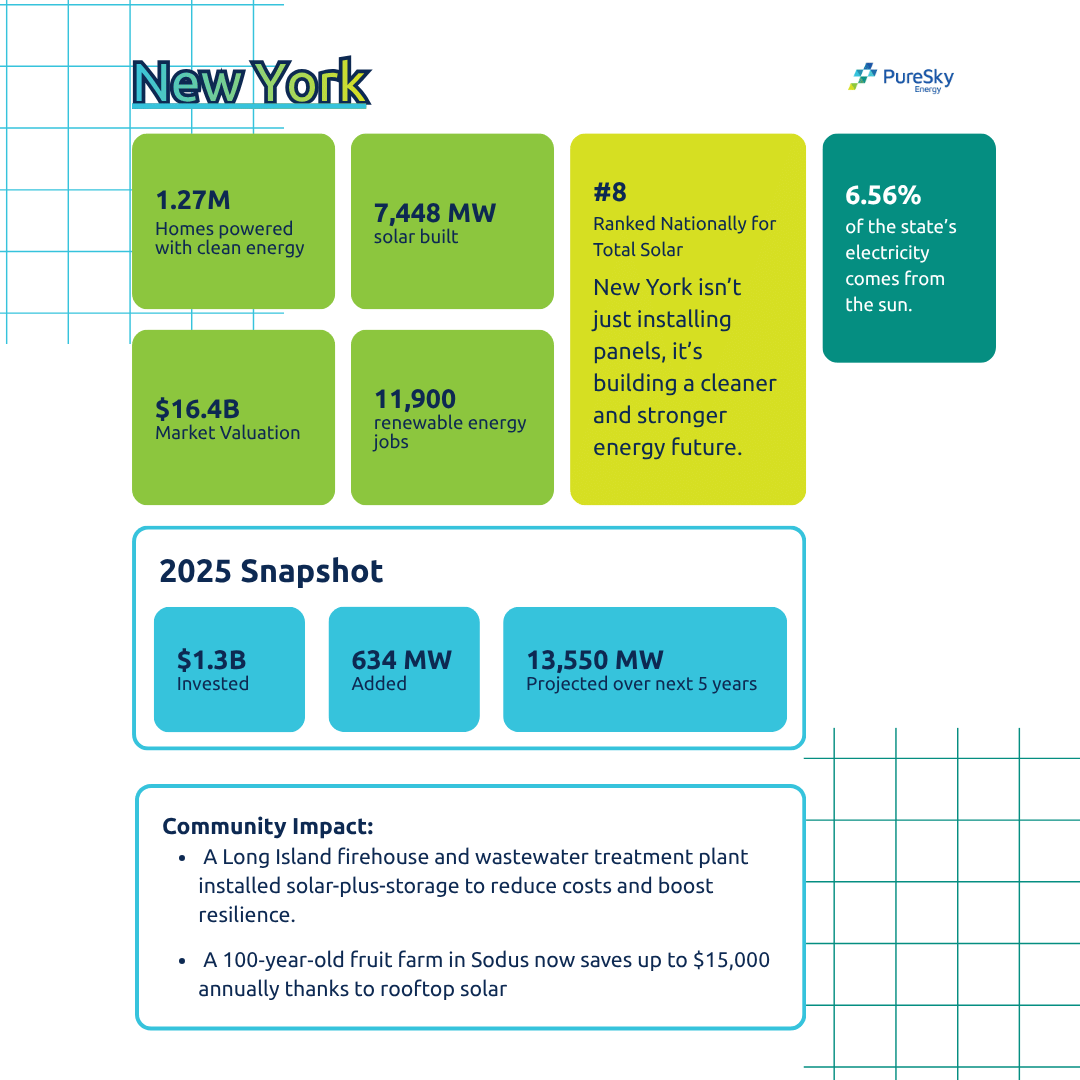
New York is rapidly becoming a national leader in solar energy. As of December 2025, solar power accounts for 6.56% of the state’s total electricity, generating enough energy to power 1.27 million homes. With 7,448 megawatts (MW) of solar installed statewide and a solar market valued at $16.4 billion, New York is proving that bold climate goals and economic growth can go hand in hand.
Expansion
New York ranks 8th in the nation for total installed solar capacity and is projected to grow by an additional 13,550 MW over the next five years. In 2025 alone, the state added 634 MW of new solar capacity, accompanied by a $1.3 billion investment.
The state’s solar industry also supports a strong workforce. More than 11,900 New Yorkers are employed in solar jobs across manufacturing, development, installation, and related services. With 741 solar companies operating in the state, including 94 manufacturers and 228 developers, New York continues to build a robust clean energy economy.
Solar Adoption Across Sectors
Solar deployment varies widely across the state’s residential, commercial, and utility sectors:
- Residential: New York ranks 5th nationally for total installed residential solar and 22nd for solar per capita. Today, 6.64% of households have solar installed.
- Non‑Residential Distributed Generation: An impressive 2nd place nationally, demonstrating strong momentum in commercial and municipal installations.
- Utility-Scale Solar: While utility-scale installations are still emerging (ranking 34th in capacity and 48th per capita) the state is gearing up for major growth in this category in the coming years.
Success Stories for New York
Behind these statistics are real communities and businesses benefiting from solar power. Two examples highlight how solar energy is strengthening local resilience and reducing costs:
A Solar-Powered Safety Net on Long Island
The Greenport Fire Department and a local wastewater treatment facility installed a combined solar‑plus‑storage system to slash energy costs and ensure reliable backup power. This investment not only improves resilience but also supports essential services for local residents.
A Century‑Old Fruit Farm Harvests the Sun
Cherry Lawn Fruit Farms in Sodus, founded in 1922, now generates a significant portion of its electricity from a rooftop solar array. The farm saves up to $15,000 each year, demonstrating how clean energy can help preserve and modernize New York’s agricultural legacy.
PureSky in New York
New York is one of PureSky’s longest running and most active portfolio states. Since 2018, PureSky has been active serving customers and building solar + storage. In 2025 alone, we started construction and launched six solar projects, including Clover Meadow, Tamarac Solar, and Green Dale Solar. Three of those projects serve income eligible households in New York through the Solar for All program – providing lower cost electricity and support clean energy development. Households and businesses can sign up for electricity savings through our community solar program – available to anyone with a utility account and in the areas we serve.
Learn more about community solar in New York »
Looking Ahead
With major growth projected over the next five years, New York stands at the forefront of America’s clean energy transition. Investments in solar power are reducing carbon pollution, strengthening the grid, supporting thousands of jobs, and helping communities thrive.
Massachusetts Solar Energy Overview

Massachusetts continues to stand out as one of the nation’s top clean‑energy innovators. As of March 2026, the Commonwealth has installed 5.8 gigawatts (GW) of solar capacity, powering nearly one million homes and helping to generate 24.62% of the state’s electricity from the sun. With a solar market valued at $13.9 billion and more than 11,000 workers employed in the industry, solar energy is firmly established as an engine of both environmental progress and economic opportunity.
Expansion
Massachusetts currently ranks 14th nationally for total installed solar capacity, reflecting years of policy support and market development. In 2025, the state invested $827 million in solar power, which paved the way for 302 MW to be installed. Massachusetts is projected to add another 1,700 MW over the next five years, which is slim compared to New York’s projected growth.
The state’s solar economy is supported by a diverse ecosystem of 474 solar and storage companies, including:
- 74 manufacturers
- 182 developers
- 218 companies specializing in installation, sales, and related services
These businesses collectively contribute to a thriving clean‑energy workforce, with 11,365 solar jobs across the Commonwealth.
Solar Adoption Across Sectors
Massachusetts shows exceptional performance in several key solar categories:
- Residential: Ranked 7th nationwide for total installed residential solar and 7th per capita. Today, 13.32% of Massachusetts households have solar on their roof.
- Non‑Residential Distributed Generation: Massachusetts ranks 3rd nationally for total commercial and municipal solar capacity and 4th per capita.
- Utility‑Scale Solar: While not yet a dominant area, Massachusetts continues to grow its utility‑scale presence, ranking 30th overall.
The state also has 1 GWh of utility‑scale storage capacity.
Success Stories
Behind these statistics are powerful stories of community impact, especially for households and organizations facing high energy burdens.
Solar Helping Lower-Income Families on Cape Cod
A home electrification program for lower‑income residents brought solar to all 55 participating households. Each home now saves an average of $150 per month on electricity bills. These savings make a meaningful difference for families that often spend a higher share of income on energy.
Boston Nonprofit to Save More Than $880,000
A low‑income housing complex south of downtown Boston installed four rooftop solar arrays, cutting electricity costs by $35,000 per year. Over the lifetime of the system, the complex is expected to save more than $880,000, freeing up resources for resident services and community support.
These examples highlight how solar energy is reducing inequality by lowering energy expenses for those who need relief most.
PureSky in Massachusetts
PureSky has been serving households and businesses in Massachusetts since 2017, and have witnessed the state’s progression to a clean energy leader – both in solar and energy storage. As an early adopter of battery energy storage paired with solar, the state set the standard for what has now become common place. PureSky launched a solar project at the end of 2025, Three Rivers, and continues to actively develop solar in the state – while serving local residents and businesses with lower cost electricity.
Learn more about community solar in Massachusetts »
Looking Ahead
Massachusetts has long positioned itself as a national leader in climate policy, and its continued investments in solar energy reflect that commitment. With an expanding solar workforce, strong consumer adoption, and meaningful community benefits, the Commonwealth is building a cleaner, fairer, and more resilient energy future.
Minnesota Solar Energy Overview

Minnesota’s clean‑energy landscape is transforming slowly, and solar power is now a central part of the state’s energy story. As of March 2026, Minnesota has installed 3.3 GW of solar capacity, which is enough to power 464,162 homes. Solar now generates 5.93% of the state’s electricity, and momentum continues to build as residents, businesses, and local governments invest in a cleaner future.
With a solar market valued at $5.1 billion, the state’s solar industry is very slowly but surely growing into a driver of economic development, job creation, and community resilience.
Expansion
Minnesota’s solar market is expanding at a steady pace. In 2025, the state added 418 MW of new solar capacity, paired with $664 million in clean‑energy investment. Over the next five years, Minnesota is projected to add another 3.3 GW, signaling strong demand and policy support for renewable energy.
The state supports:
- 172 solar and storage companies
- 37 manufacturers
- 57 developers
- 78 installers and related service companies
Altogether, the industry employs 4,793 Minnesotans, supporting a broad clean‑energy workforce that spans construction, engineering, manufacturing, and maintenance.
Minnesota’s Solar Rankings
Minnesota displays slow growth across several solar market categories:
- 20th for total installed solar capacity
- 26th for total residential solar
- 6th for non‑residential distributed generation (a major strength for the state)
- 20th for utility‑scale solar
- 1.35% of Minnesota homes now have solar installed
While residential installations remain modest compared to other states, Minnesota’s commercial and municipal solar sectors (including schools, fire stations, and local government facilities) are driving much of the state’s growth.
Minnesota has also deployed 34 MWh of utility‑scale storage, an important step in boosting grid reliability and integrating more solar energy.
Success Stories
Behind the data are real communities saving money and improving resilience through solar power. Two recent examples showcase how Minnesota is turning solar adoption into meaningful local impact.
Eden Prairie Fire Station Saves with Solar
A new rooftop solar installation on an Eden Prairie fire station near Minneapolis now provides one‑third of the building’s electricity. The system saves the station $5,500 each year, and over 25 years, the installation is expected to save $140,000.
For a community facility that must remain operational during emergencies, solar energy not only cuts costs but also enhances energy reliability.
Ramsey County Cuts Energy Costs Across 11 Ice Rinks
In Ramsey County, a major energy‑efficiency upgrade is bringing solar to 11 ice rinks. Once complete, the county expects to save $300,000 annually on energy bills.
These savings help local governments reinvest in public services, recreation programs, and facility improvements, demonstrating how solar benefits extend far beyond clean power.
PureSky in Minnesota
PureSky’s Minnesota portfolio consists of 5 solar farms, serving Xcel customers. We continue to support our customer base in spite of changes to the program in 2025 that reduced the value of community solar for customers. PureSky now guarantees a 10% savings in Minnesota to pass on those savings.
Learn more about community solar in Minnesota »
Looking Ahead
Minnesota’s clean‑energy story is still unfolding, but the trajectory is clear: more solar, more local savings, more jobs, and more investment across the state.
With steady demand over the next five years, Minnesota is emerging as a regional leader in commercial solar, community solar, and public‑sector renewable energy adoption. The state’s expanding solar portfolio is helping households lower energy bills and reduce carbon emissions.
Illinois Solar Energy Overview
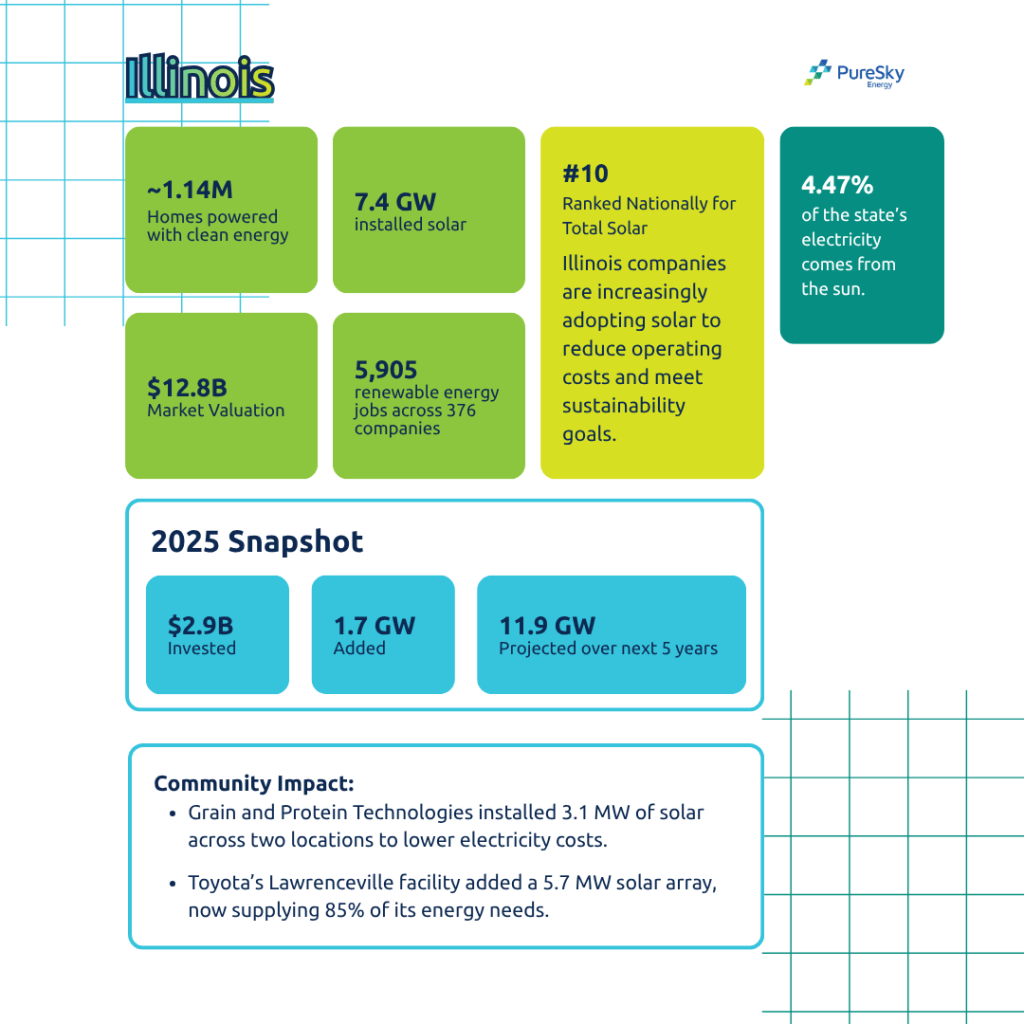
Illinois is rapidly emerging as one of the Midwest’s most dynamic clean‑energy leaders. As of March 2026, the state has installed 7.4 GW of solar capacity, which is enough to power more than 1.14 million homes. Solar now provides 4.47% of Illinois’ electricity, reflecting a fast‑growing market that is transforming how the state generates and consumes power.
This progress is backed by a solar economy valued at $12.8 billion, supported by 5,905 solar workers and 376 solar and storage companies operating across the state.
Expansion
Illinois’ solar market ranks 5th in the nation for annual growth. In 2025 alone, the state installed 1.7 GW of new solar capacity and attracted $2.9 billion in investment. For reference, 1.7 GW is what Massachusetts is projected to develop over the next five years. Illinois managed to do this in one.
Looking ahead, Illinois is projected to expand by an additional 11.9 GW over the next five years. This anticipated growth highlights the state’s increasingly strong policy and regulatory environment, robust demand for clean energy, and expanding opportunities for households, businesses, and manufacturers.
The state’s solar industry includes:
- 92 manufacturers
- 101 developers
- 183 installers and service companies
Illinois’ Solar Rankings
Illinois performs well across a variety of market categories:
- 10th for total installed solar capacity
- 9th for residential solar
- 5th for non‑residential distributed generation
- 11th for utility‑scale solar
- 3.84% of Illinois homes now have solar
While the state is still building out its utility‑scale capacity, its commercial and industrial sectors have become standout performers. Many Illinois businesses are turning to solar to reduce operating costs, meet sustainability goals, and improve long‑term energy resilience.
Illinois has also installed 16 MWh of utility‑scale storage.
Success Stories
Behind Illinois’ rapid growth are real stories of companies turning to solar to cut costs and improve energy reliability. Two recent examples show how solar is driving economic and operational benefits for major industries in the state.
Farm Feed Manufacturer Lowers Costs Through Solar
Grain and Protein Technologies, a feed manufacturer with facilities in Paris and Taylorville, installed solar arrays at both locations. Combined, these projects total 3.1 MW of solar capacity. The systems provide low‑cost electricity directly to the manufacturing operations, lowering energy expenses and improving the company’s long‑term cost structure.
Toyota’s Illinois Facility Cuts Energy Use With Solar
Toyota partnered with Onyx Renewables to install a 5.7 MW solar array adjacent to its Lawrenceville manufacturing facility. The project now supplies 85% of the plant’s electricity needs, significantly reducing operational costs and supporting the company’s broader sustainability commitments.
Projects like these demonstrate how solar is becoming a valuable asset for Illinois manufacturers by improving efficiency, reducing expenses, and contributing to the state’s economic competitiveness.
PureSky in Illinois
Illinois is an exciting new market for PureSky. With several community solar farms having started construction in 2025, we are looking forward to launching community solar programs in Illinois this year. One community solar farm is dedicated solar to income eligible households in Ameren, McLean Solar 1. A second set to launch this year, WildCat, is open to any customers in the ComEd service area.
Learn more about community solar in Illinois »
Looking Ahead
Illinois’ solar momentum reflects a statewide shift toward clean energy. With strong growth projections, major corporate investments, and increasing residential adoption, Illinois is positioning itself as a leading clean‑energy state in the Midwest.
The benefits of this transition are tangible:
- Lower energy costs for businesses and households
- Job growth and expanded clean‑energy career paths
- Greater grid resilience through distributed generation
- Long‑term economic development and investment
Maryland Solar Energy Overview
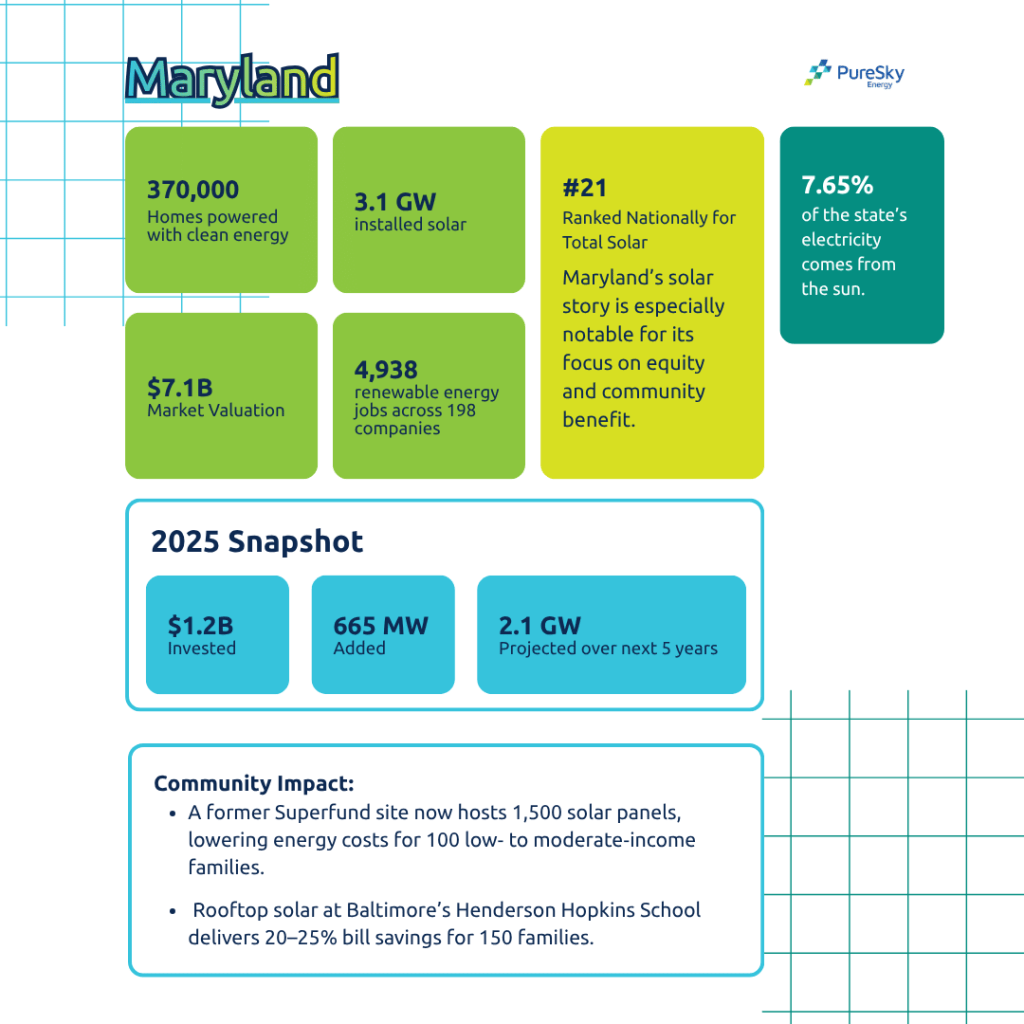
Maryland continues to advance its clean‑energy leadership with a growing solar market that is reshaping the state’s energy landscape. As of March 2026, Maryland has installed 3.1 GW of solar capacity—enough to power 369,814 homes. Solar now supplies 7.65% of the state’s electricity, reinforcing the role of renewable energy in Maryland’s economic and environmental future.
This growth is supported by a solar economy valued at $7.1 billion, alongside 4,938 workers employed across 198 solar and storage companies statewide.
Expansion
Maryland’s solar capacity continues to expand, with some growth expected over the next several years. In 2025, the state added 665 MW of solar, accompanied by $1.2 billion in investment. Over the next five years, Maryland is projected to add another 2.1 GW of solar capacity as demand increases among homeowners, schools, local governments, and businesses.
The companies driving this progress include:
- 17 manufacturers
- 100 developers
- 81 installers and service providers
Together, this supports a clean‑energy workforce and builds the infrastructure necessary for long‑term renewable energy adoption.
Maryland’s Solar Rankings
Maryland performs competitively across multiple categories:
- 21st for total installed solar capacity
- 11th in residential solar
- 8th in non‑residential distributed generation
- 27th in utility‑scale solar
- 6.37% of Maryland households now have rooftop solar
The state has also installed 23 MWh of utility‑scale storage.
Success Stories
Innovative projects in historically underserved or environmentally challenged communities highlight how solar energy can deliver economic, environmental, and social benefits.
Solar Brings New Life to a Former Superfund Site
One of the most contaminated sites in Maryland, previously unsafe for traditional redevelopment, has found new purpose through clean energy. A solar installation featuring 1,500 panels was built on this former Superfund site, now generating low‑cost electricity for 100 low‑ to moderate‑income families.
By turning a polluted property into a source of clean power, Maryland is demonstrating how renewable energy can contribute to both environmental recovery and community affordability.
Baltimore School Rooftop Solar Helps Lower Household Bills
In Baltimore, 1,600 solar panels installed on the rooftop of Henderson Hopkins School are generating substantial savings for local households. The system delivers 20–25% reductions in electricity bills for 150 low‑ to moderate‑income families.
Not only does this project reduce energy burdens, it also showcases how public buildings can play a vital role in expanding equitable access to clean energy.
PureSky in Maryland
PureSky is just about to launch our first Maryland community solar farm with one of the most innovative racking systems on the market. We also continue to develop and expand our portfolio with more solar farms in the pipeline.
Learn more about community solar in Maryland »
Looking Ahead
Maryland’s solar progress reflects a broader commitment to environmental leadership, community investment, and economic opportunity. With growth projected to continue and more households and institutions turning to solar, the state is well‑positioned to expand its clean energy footprint.
Key benefits of Maryland’s solar expansion include:
- Lower energy bills for families and businesses
- New investments in local jobs and clean‑energy industries
- Revitalization of previously unusable or contaminated land
- Improved energy resilience through distributed generation
- Expanded access to renewable energy for underserved communities
These are just a few examples of how solar and storage facilities are improving state economies and community well-being. As demonstrated, policy advocacy paves the way for an energy future where people can rely on affordable and consistent access to electricity.
For more information on solar advocacy, see Where Does Community Solar Need Your Support?