



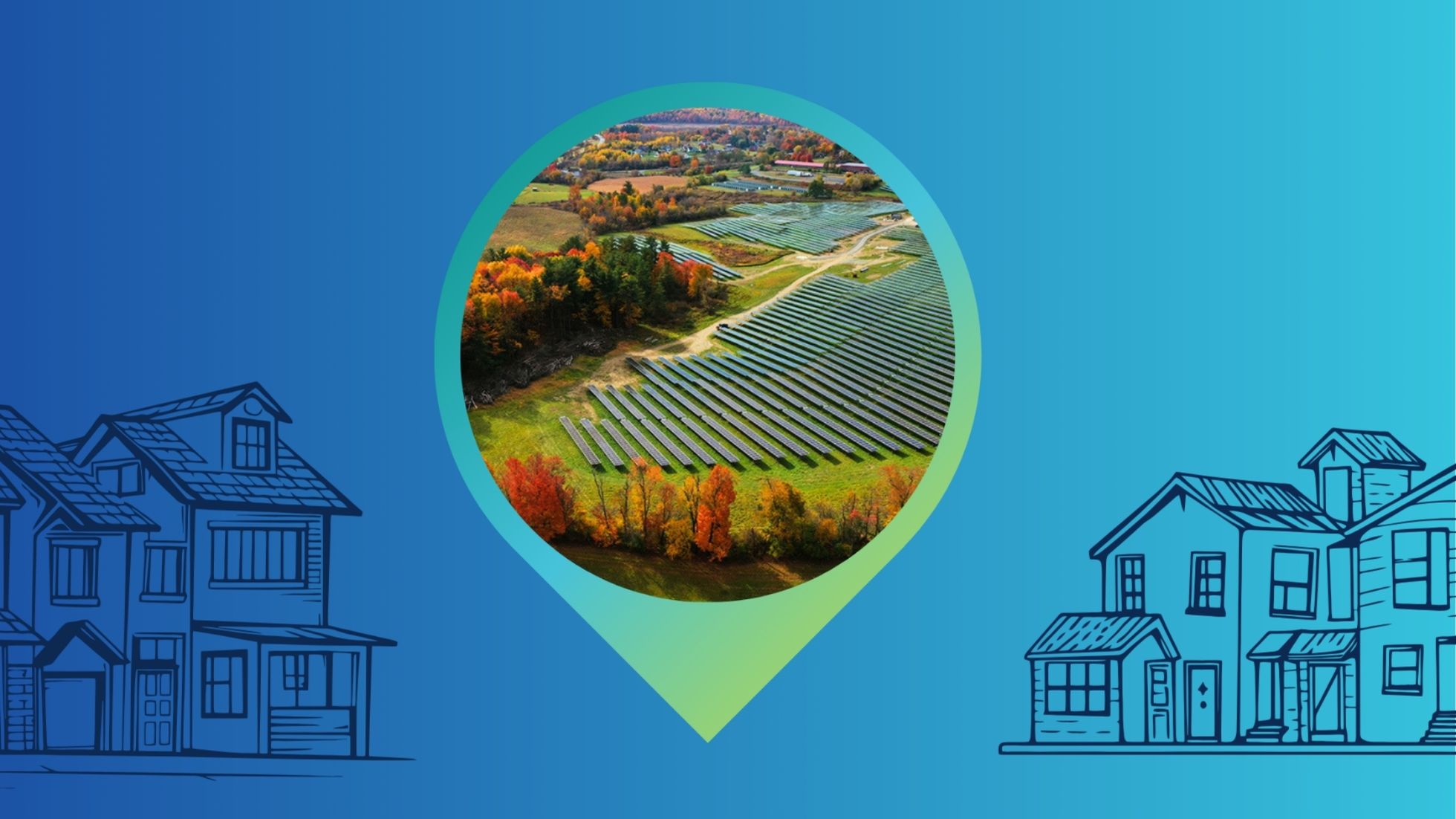
Do property values decrease if they’re next to a solar farm?
In short, no. But the property type, time, and proximity all matter. Read on to get the full story and links to research.
There’s a story that gets told every time a new solar farm is proposed: homeowners fear their property values will plummet. The logic seems intuitive—who wants to live next to a sea of panels? But intuition isn’t evidence, and when you dig into the data, the picture looks very different.
The Big Study Everyone Should Know About: Key Findings
A comprehensive study by Virginia Tech and the University of Rhode Island analyzed nine million property transactions near 3,699 utility-scale solar sites. The results were striking:
- Farmland values increased by nearly 19 percent within two miles of solar farms.
- Residential properties experienced a modest decline of about 4.8 percent within three miles.
- These effects diminished over time, suggesting that initial perceptions drive much of the impact.
Why? Solar farms are new, and novelty breeds anxiety. But as they become part of the landscape, the stigma softens.
Zooming Out: What Other Research Says about Solar and Property Values
Additional studies confirm similar trends. Homes within half a mile of solar farms may see a 1.5 to 3 percent decrease in value, but most properties farther away show neutral effects. In some cases, values even rise when developers implement landscaping and community benefit programs.
And here’s the kicker: property assessors—those responsible for valuations—report that solar farms generally have no measurable impact on property values. Negative perceptions tend to be strongest for large, unscreened facilities – greater than 20 megawatts. Just for perspective, PureSky Energy builds typically community solar farms at 5 megawatts and smaller.
The fear is louder than the facts.
The Factors That Matter
Distance matters. Size matters. Screening matters. A 100-megawatt facility without buffers is a different story than a 20-megawatt site tucked behind trees. And time matters most—solar farms stop being “projects” and start being “part of the view.”
- Distance: Closer proximity correlates with more noticeable effects.
- Size: Larger projects may have greater visual impact.
- Mitigation Measures: Landscaping and buffers reduce negative perceptions.
- Time: Impacts fade as solar becomes normalized in the landscape.
Research on Community‑Scale Solar Projects and Property Values
PureSky Energy typically builds community solar projects – and at around 5 megawatts or smaller – they are only one-fourth the size or less than large- or utility-scale solar projects. Current research specific to community solar suggests more favorable outcomes compared to large-scale solar farms:
Loyola University / Kane County Case
A study of 70 midwestern solar farms ranging from 5 to 100+ MW found that smaller community-scale projects (5–20 MW) tend to have neutral or slightly positive impacts on nearby residential property values, often in the range of +0.5% to +2.0%. These positive effects are linked to predictable land use, proper setbacks, and visual buffers such as landscaping. Neighbor feedback emphasized that calm, low-traffic characteristics were preferable to uncertain future land uses, which boosted perceived land stability.
Wisconsin Rural Partnerships Institute Brief
A review of broader literature notes that while utility-scale solar impacts are well-studied, public perceptions of community-scale solar remain less clear. However, early evidence suggests these smaller projects are generally viewed more favorably, especially when designed with community input and visual mitigation measures.
What Abutters Can Do to Mitigate Potential Impacts
If you live near a proposed solar farm, there are practical steps you can take to protect your property value and improve your experience:
Advocate for Visual Screening
Request that developers include vegetative buffers, berms, or fencing to reduce visual impact. Studies show that screening significantly lessens negative perceptions.
Engage in the Planning Process
Attend public hearings and provide input on siting, setbacks, and landscaping requirements. Many jurisdictions allow abutters to influence design standards.
Negotiate Community Benefits
Some developers offer programs such as tax relief, local hiring, or community solar subscriptions. These benefits can offset perceived disadvantages.
Monitor Maintenance Standards
Ensure agreements include upkeep of landscaping and fencing over the life of the project. Poor maintenance can amplify visual concerns.
Stay Informed About Long-Term Trends
Research indicates that property value impacts diminish over time. Communicating this to potential buyers can help counter misconceptions.
Putting Property Value Concerns in Perspective
The evidence is clear: large-scale solar projects have only modest, short-term effects on nearby residential property values, and those impacts fade over time. Farmland often sees a boost, and homes farther from the site typically remain unaffected.
When it comes to community solar projects, the outlook is even better—research shows these smaller installations generally have neutral or slightly positive impacts on property values, especially when designed with proper setbacks and landscaping. In other words, living near a solar project doesn’t mean your home will lose value—and in many cases, thoughtful planning can make solar a net positive for the community.

References
- Elmallah, S., Chenyang Hu, Zhenshan Chen, Pengfei Liu, Wei Zhang, Xi He, and Darrell Bosch. “Impact of Large‑Scale Solar on Property Values in the United States: Diverse Effects and Causal Mechanisms.” Proceedings of the National Academy of Sciences, June 2025. https://www.pnas.org/doi/10.1073/pnas.2418414122
- Gaur, Vasundhara, and Corey Lang. “Proximity to Solar Farms and Residential Property Values.” Journal of Real Estate Research, 2023. https://www.uri.edu/news/wp-content/uploads/news/sites/16/2020/09/PropertyValueImpactsOfSolar.pdf
- Lawrence Berkeley National Laboratory and University of Texas at Austin. “Property‑Value Impacts Near Utility‑Scale Solar Installations.” LBNL Report, 2024. https://www.aes.com/sites/aes.com/files/2025-04/Solar-and-Property-Values.pdf
- Louisiana State University Center for Energy Studies. “Literature Review on the Impact of Utility‑Scale Solar on Housing Prices.” LSU Report, August 2024. https://www.lsu.edu/ces/publications/2024/solar_energy_and_housing_prices_lit_review_aug_30_2024.pdf
- SEIA (Solar Energy Industries Association). “Solar and Property Value Factsheet.” September 2019. https://seia.org/wp-content/uploads/2019/09/Solar20Property20Value20FactSheet202019-PRINT_1-1.pdf
- Virginia Tech News. “Virginia Tech Study Sheds Light on Solar Farm Impacts to Property Values.” June 9, 2025. https://news.vt.edu/articles/2025/06/solar-property-value.html
- University of Wisconsin–Madison. “Updated Impact of Proximity to Solar Farms on Property Values.” Wisconsin Rural Partnerships Institute Report, June 11, 2025. https://aae.wisc.edu/pdmitchell/wp-content/uploads/sites/15/2025/06/Solar_land_value_impacts_Update-1.pdf
- Kane County Zoning Packet. “Home Valuation Near Solar Field Study Summary.” Loyola University Chicago, 2024. https://www.kanecountyil.gov/FDER/Zoning%20Petitions%20Documents/4661_35_Property%20Value%20Memo%20&%20Study%20%28Rcvd.%2007-11-2025%29.pdf
Follow us on Social
Stay up to date with everything to do with community solar, renewable energy, and sustainability on your favorite platform.


